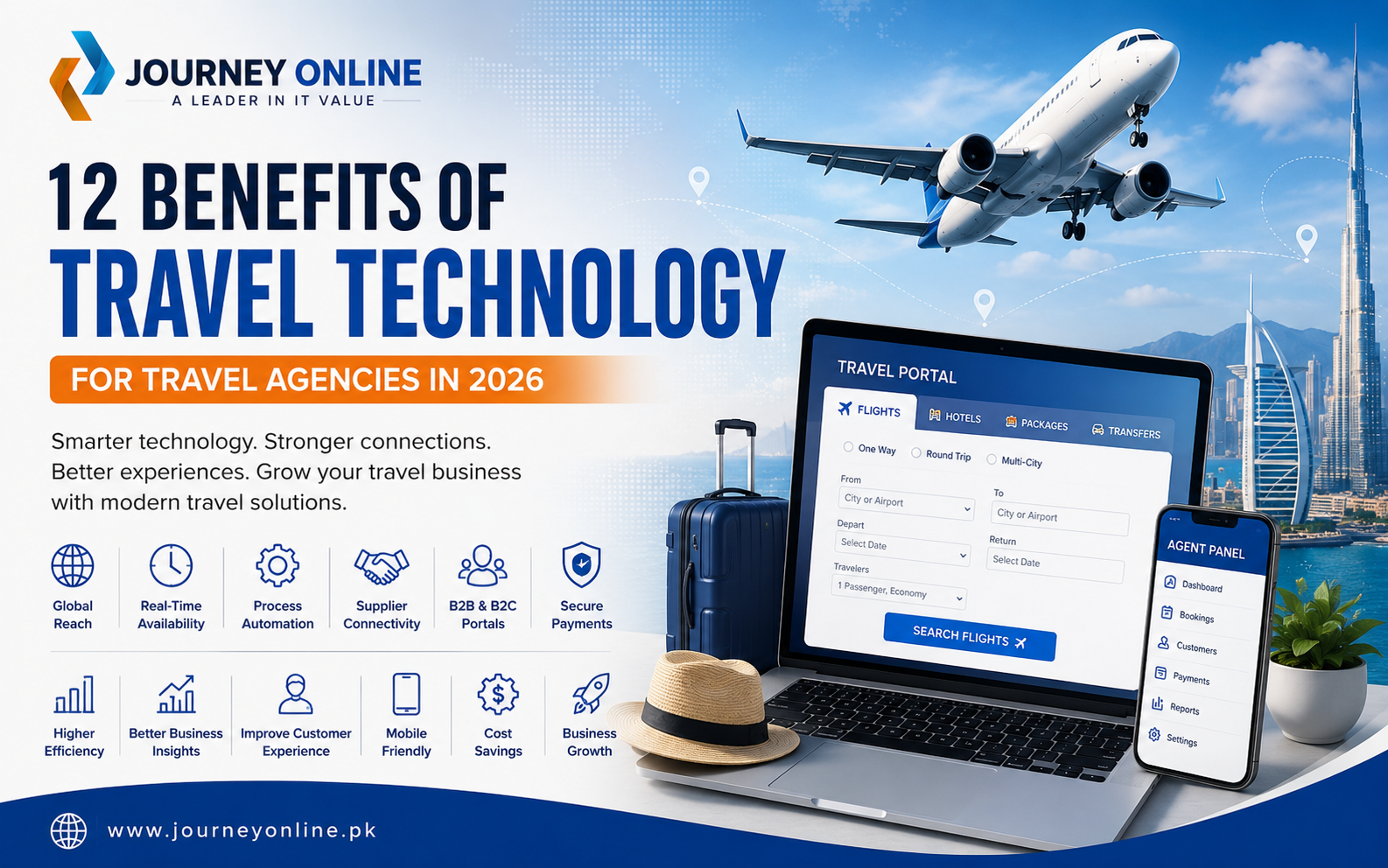
Introduction
Table of Contents
What Is Travel Technology
Smarter Technology for a Faster Growing Travel Business
The travel industry is changing quickly. Customers expect instant flight searches, hotel availability, online payments, quick confirmations, and a smooth booking experience across mobile and desktop devices. At the same time, travel agencies need better tools to manage suppliers, bookings, customers, agents, payments, and operations.
This is where travel technology becomes essential.
Modern travel technology can connect airlines, hotels, GDS platforms, payment gateways, booking systems, CRM tools, and business management solutions into a connected digital ecosystem. For travel agencies, tour operators, OTAs, DMCs, and corporate travel companies, the right technology can reduce manual work while creating new opportunities for growth.
Journey Online helps travel businesses build and connect digital travel solutions, including travel portals, booking platforms, API integrations, and customized travel software.
Why Travel Agencies Need Technology in 2026
The digital foundation of modern travel
Travel technology refers to the software, platforms, APIs, booking systems, automation tools, and digital infrastructure used to operate and sell travel services.
It can include:
- Airline API integration
- Hotel API integration
- GDS integration
- Online booking engines
- B2B travel portals
- B2C travel portals
- Travel agency management software
- Payment gateway integration
- Customer management systems
- Supplier management
- Online itinerary systems
- Reporting and business dashboards
Instead of managing every operation separately, travel businesses can connect these functions through integrated technology.
12 Key Benefits of Travel Technology
Journey Online Specialize in Travel Technology
1. Expand Your Online Reach
Sell beyond your physical office
A digital travel platform allows an agency to reach customers beyond its local market.
Instead of depending entirely on walk-in customers or phone enquiries, agencies can showcase flights, hotels, tours, transfers, and other services online.
A well-developed travel portal can support customers across different cities and countries, creating opportunities for international growth.
2. Offer Real Time Travel Availability
Give customers faster answers
Travel prices and availability can change frequently.
API and GDS integrations can connect a booking platform with travel suppliers and provide current information about available flights, hotel rooms, fares, and other travel products.
This reduces the need for staff to manually check multiple supplier systems for every customer enquiry.
3. Automate Booking Operations
Turn manual processes into digital workflows
Manual booking processes consume valuable staff time and can increase the possibility of human error.
A modern booking platform can automate important steps such as:
- Search
- Availability checking
- Booking
- Passenger information
- Payment
- Confirmation
- E-ticket generation
- Booking management
Automation allows staff to spend more time on customer service and sales rather than repetitive administrative tasks.
4. Connect Global Travel Suppliers
Bring multiple travel sources together
Travel businesses often work with several airlines, hotel suppliers, GDS platforms, wholesalers, and other providers.
Instead of forcing employees to work across disconnected systems, API integration can bring relevant travel content into a single platform.
For example, a travel portal can connect airline APIs for flights, hotel APIs for accommodation, GDS systems for broader inventory, and payment gateways for online transactions.
5. Build B2B Travel Portals
Create a stronger agency network
B2B travel portals can help agencies manage relationships with sub-agents, corporate clients, and business partners.
A B2B platform can provide features such as:
- Agent registration
- Login accounts
- Credit management
- Markups
- Special rates
- Booking management
- Invoices
- Reports
- Agent-specific access
This can help travel companies build scalable distribution networks without depending entirely on manual communication.
6. Create B2C Booking Platforms
Let customers book directly
A B2C travel portal gives customers direct access to travel products.
Customers can search for their preferred service, compare available options, enter traveller information, make payments, and receive booking confirmations online.
This creates a more convenient buying experience while allowing the travel company to generate bookings outside normal office hours.
7. Improve Customer Experience
Make every booking easier
Technology should not only make business operations easier. It should also make the customer journey simpler.
A well-designed travel platform can provide:
- Simple navigation
- Fast search
- Clear pricing
- Multiple payment options
- Mobile-friendly booking
- Instant confirmations
- Booking history
- Customer accounts
- Online support
A smoother experience can help businesses build trust and encourage repeat bookings.
8. Reduce Operational Costs
Do more with fewer manual processes
Automation can reduce the amount of repetitive work performed by employees.
For example, instead of manually preparing every booking confirmation, invoice, or report, software can generate these documents automatically.
This can improve productivity and allow employees to focus on higher-value activities such as customer relationships, sales, partnerships, and business development.
9. Manage Travel Data More Efficiently
Turn booking data into business insight
Every booking creates valuable information.
Travel businesses can use their technology platform to understand:
- Popular destinations
- Booking trends
- Customer preferences
- Sales performance
- Agent performance
- Supplier performance
- Revenue patterns
- Cancellation trends
With better reporting, management can make decisions based on actual business data instead of assumptions.
10. Improve Payment Management
Make transactions more convenient
Online payment integration can simplify the payment process for customers while helping businesses manage transactions more efficiently.
Depending on the market and business model, a travel platform can support appropriate payment gateways and transaction workflows.
Automated payment records can also make reconciliation and financial reporting easier.
11. Scale Your Travel Business
Technology that grows with you
A travel agency may begin with a small website and a few employees but eventually expand into a larger operation with multiple branches, agents, suppliers, and markets.
A scalable travel technology solution can support this growth.
Instead of replacing the entire system whenever the business expands, agencies can add new integrations, services, users, markets, and functionality as required.
12. Gain a Competitive Advantage
Compete with a better digital experience
Travel businesses compete not only on price but also on convenience, speed, service, and trust.
An agency with a modern booking platform can provide customers with a more convenient experience than a business relying entirely on manual processes.
In an increasingly digital travel market, technology can help smaller and growing travel businesses compete with larger companies by improving their online presence and operational efficiency.
Travel Technology Solutions by Journey Online
Build the system your travel business needs
Journey Online develops and integrates digital travel solutions for agencies, OTAs, tour operators, DMCs, and other travel businesses.
Our solutions can include:
Airline API Integration
Connect your platform with flight inventory, fares, schedules, availability, and booking functionality.
Hotel API Integration
Access hotel content, availability, rates, and booking capabilities through suitable supplier integrations.
GDS Integration
Connect your travel platform with GDS technology to access broader travel inventory and distribution capabilities.
Travel Portal Development
Build customized B2B, B2C, or hybrid travel portals according to your business model.
Booking Engine Development
Create streamlined booking experiences for flights, hotels, tours, transfers, and other travel services.
Customized Travel Software
Develop software around your specific workflows, requirements, users, suppliers, and operational processes.
How to Choose Travel Software
Choose technology around your business model
Not every travel company needs the same system.
Before selecting or developing travel software, consider:
- What travel products do you sell?
- Do you need B2B, B2C, or both?
- Which suppliers need to be integrated?
- Do you require airline or hotel APIs?
- Do you need GDS connectivity?
- Which payment methods will customers use?
- How many agents or users will access the system?
- Do you need customized reporting?
- Will the platform need to support multiple countries or currencies?
- Can the technology scale with your business?
The best travel technology is not necessarily the platform with the largest number of features. It is the solution that fits the business and can evolve as the business grows.
The Future of Travel Technology
Connected automated and customer focused
The next generation of travel businesses will increasingly depend on connected digital systems.
AI-assisted discovery, automation, real-time data, personalized customer experiences, digital payments, API connectivity, and cloud-based platforms are changing how travel businesses operate. Current marketing and technology trends also show that businesses are moving from isolated digital tools toward integrated systems that connect data, customer journeys, and business operations.
For travel companies, the opportunity is not simply to put their business online. It is to build a connected digital infrastructure that can support customers, suppliers, agents, bookings, payments, and growth.
Frequently Asked Questions
Quick answers for travel businesses
What is travel technology?
Travel technology is the use of software, APIs, booking systems, platforms, and digital tools to manage, sell, distribute, and operate travel services.
Why do travel agencies need software?
Travel software can help agencies automate bookings, manage customers and suppliers, process payments, generate reports, and provide customers with faster digital services.
What is a travel API?
A travel API allows one software system to communicate with another system and exchange travel-related information such as availability, pricing, schedules, and booking data.
What is GDS integration?
GDS integration connects a travel platform with a Global Distribution System, allowing travel businesses to access and distribute travel inventory through connected technology.
What is a B2B travel portal?
A B2B travel portal is a platform designed for travel agents, sub-agents, corporate clients, or business partners to search, book, manage, and access travel products.
Can Journey Online build a customized travel portal?
Yes. Journey Online can develop customized travel portals and software based on a company's business model, required integrations, workflows, users, and travel products.
Is travel technology suitable for small travel agencies?
Yes. A properly planned solution can be designed around the agency's current requirements and expanded as the business grows.